

Earlier today, I dropped the following question in the IIT Madras entrepreneurs’ group on WhatsApp - that I am part of.
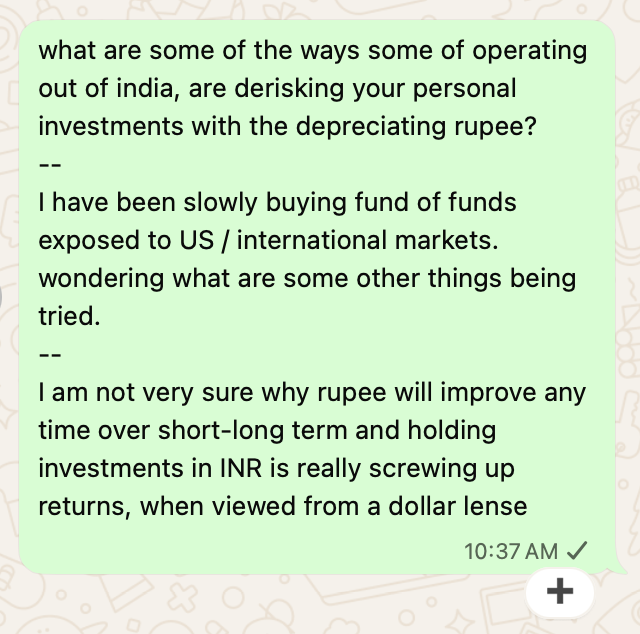
I wanted help in making smarter decisions with my own savings. Many useful answers / suggestions followed. This blog is an attempt to create a useful summary for myself (for future). Also, putting it out there in the hope that these suggestions / insights benefit others too.
-Amrit (here’s my short bio)
Overall summary
Add global equity exposure
This can be through Indian fund-of-funds, direct US stocks/ETFs, or UCITS ETFsUse overseas brokerage accounts for serious global allocation
IBKR came up repeatedly as the most flexible route, especially for UCITSConsider UCITS once the portfolio becomes meaningful
This is mainly to manage US estate tax risk while still getting global market exposureMatch assets with future liabilities
If your future expenses may be in dollars, pounds, euros, or Singapore dollars, holding everything in INR is riskyUse advisors only when the fee model is clean
Flat-fee advice is easier to trust than commission-led or AUM-led adviceDon’t confuse available products with good strategy
Just because one international fund is open for investment does not mean it belongs in your portfolio
Alright, let me elaborate these points one by one. If you have your own POV on this, do share in the comments. Thanks.

1. Indian international fund-of-funds: easy, but limited
One approach is obviously to invest in Indian mutual funds or fund-of-funds that offer exposure to US or global markets - something that I have been doing lately.
For example, I’ve bookmarked https://thefynprint.com/feeder-funds-tracker - which lets me know which fund-of-funds are open to invest in. My friend Vineet (founder of Atypical Advantage) had let me know about it - so thankful to him. You can use the standard India-based platforms to do these investments (I use Mobikwik and Zerodha).
The limitation of this approach, as someone pointed out in the group, is that it’s not always reliable in the sense that many international mutual fund schemes in India are closed or restricted for fresh inflows. So one may end up investing not in the best available global exposure, but in whatever happens to still be open (which I agree with). And that’s an odd approach to build a long-term investment strategy! :)
Then there is the issue of thematic distortion. For example, if the only available global fund has exposure to a niche theme like water, healthcare, or energy transition, you may be taking a sector bet when your actual goal was just global diversification.
Net, net, fund-of-funds do work as a good starting point (better than letting your hard-earned savings deplete just because you own them in rupee that is getting worse by the day). But clearly not the best sustainable long-term strategy.
2. Direct US investing through apps: convenient, but watch the fine print
Another common route is to use apps like Vested, INDmoney, or similar platforms to buy US stocks and ETFs.
The appeal is obvious. You can buy Apple, Microsoft, Nvidia, S&P 500 ETFs, Nasdaq ETFs, and so on. The account opening process is relatively smooth, I understand. For many Indians, this also seems to be the first real step outside INR assets. For example, I checked with my brother on how he was de-risking against a depreciating rupee and he shared that he was doing it through INDmoney. Is that also your strategy?
Two concerns came up in the group.
One - the foreign exchange spread: when money is converted from INR to USD, the exchange rate is not always transparent. You may lose money at the conversion stage itself.
Two - (maybe more serious than the first, for some) - US estate tax risk: for non-resident investors, US situs assets above a certain threshold can become exposed to estate tax if the investor passes away. One participant pointed out that this can apply not only to US stocks and ETFs bought through investing apps, but also to RSUs.
I don’t think either of these concerns mean that direct US investing is bad. But clearly beyond a certain portfolio size, you might want to understand the structure properly. I am still not sure I want to go this route. Especially now that I understand option 3 as well.
3. IBKR + UCITS: the serious DIY route
This was the most discussed route - here you essentially open an account with an international broker, especially Interactive Brokers, and then get to invest through UCITS ETFs.
UCITS funds are typically Ireland-domiciled ETFs or funds that give exposure to global indices, including US markets, but without holding the investment as a US-domiciled ETF directly. So for Indian residents, it basically reduces the US estate tax problem while still allowing exposure to the same underlying markets.
This is what I’ve understood - let’s say you want S&P 500 exposure. Instead of buying a US-domiciled S&P 500 ETF, you just buy an Ireland-domiciled UCITS ETF that tracks a similar index:
Use LRS from your Indian bank account
Move money to an international brokerage account
Buy global ETFs, preferably UCITS beyond a certain threshold
Keep investing regularly
Use India-based assets mainly for India-based needs
I did some digging. I don’t think this is the easiest route.
IBKR felt more complex than the consumer apps I am used to (but may be if I may get used to IBKR too - these are early vibes). But what’s clear is that, going the IBKR route also means that the onus of things like tax reporting, LRS paperwork, foreign asset disclosure (which thankfully I don’t have for now) etc. - all of that rests on me. :/
I did find a hack (thanks to Claude) - https://paasa.com/ - which is essentially a layer on top of IBKR but takes care of these other things it seems. Seriously considering it now.
Anyway, if you are someone who likes to manage your own money, IBKR seems to be the most robust DIY approach. And maybe if you are that person, you already know about it. Do you?
In fact one fellow entrepreneur shared they had more than 90% of their net worth in USD-denominated investments, mostly UCITS through IBKR, because of
dislike of Indian restriction on moving capital
overseas investments historically benefitting from currency depreciation, and
a large part of their family expenses being abroad
If your child is going to study abroad in the future (if not presently), if you travel internationally often, or if you think you might relocate outside the country (or spend significantly abroad for any other reason), then holding everything in INR makes little sense.
4. Other broker options
Vested - someone said they personally use Vested, noting that some global fund investments there are structured as UCITS (also looks like Vested is more popular among sub-cr or few cr. international portfolios, while IBKR is preferred north of that).
Charles Schwab - was also mentioned as a strong broker that supports Indian customers. But there’s a caveat - Schwab may not support UCITS in the same way, so it may be better suited for US treasuries or for keeping US investments below the estate-tax threshold.
I guess on one hand, the consumer investing apps are relatively easier to deal with while the global brokers offer more flexibility. Banks feel safer to some people. Each route has its own trade-offs and everyone will have to arrive at their preference on their own.
The “best” answer will probably depend on the size of the portfolio, comfort with paperwork, need for UCITS, and how much handholding you want.
5. Overseas bank accounts: peace of mind, at a cost
One fellow entrepreneur said after exploring GIFT City, IBKR, fund-of-funds, Indian global ETFs, and other routes, they finally opened an overseas account with DBS Singapore alongside a DBS India account.
The logic was not necessarily purley cost optimization, but also ‘comfort’.
Through the Singapore account, they could access shares, ETFs, funds, and fixed income. They kept doing LRS from India. They also used IBKR through a spouse’s account, but felt more comfortable holding larger sums with a regulated bank in a stable country.
This did lead to some debate on cost. Overseas banks may charge trading fees and custody fees. In the example discussed, ETF trading fees were around 0.10%–0.25%, with an annual custody fee of around 0.2%.
I guess for a buy-and-hold investor, that should be acceptable. But obviously for someone optimizing every basis point, it will feel painful. And not justifiable.
Also, what risk does a foreign bank really reduce - compared to a large global broker like IBKR? Maybe the answer is just emotional. A bank in Singapore could feel safer? But for others, the answer might not be convincing enough to justify additional custody fees.
Risk tolerance is not purely mathematical of course. So to each their own.
6. Professional advisors: useful, but incentives matter
The conversation also brought up the role of SEBI-registered investment advisors.
One argument in favour of a SEBI RIA is that they cannot earn commissions from distribution. In theory, this removes a major conflict of interest.
You can think of going to a doctor versus going to a pharmacist - the pharmacist may earn from the product being sold; the doctor is supposed to advise you based on your interest.
But the group also pushed back. SEBI registration alone does not guarantee quality.
The better model seemed to be: work with a vetted, fixed-fee advisor who helps with goal mapping, broker account opening, UCITS selection, LRS process, foreign asset reporting, estate tax complications, and tax filing.
Also, the fixed-fee point matters. Several people in the group seemed allergic to wealth managers charging 0.5%–1% of assets every year. I also don’t get the logic of paying life-long for a one-time help (or few times). Over decades, just that cut becomes a massive drag on returns.
Another warning that came up in the group was - advisors also do get commissions from foreign banks or brokers for account opening and transfers. So even in global investing, incentives are messy.
I guess, go ahead and take advice - but understand how the advisor makes money? :) Then see what you want to decide, for yourself.
7. Gold, real estate, and “FD-MF-Gold-House” thinking
Someone did a WhatsApp poll on different attitudes towards investment - many in the group were fine with the conventional FD, mutual funds, gold, house type of route.
In India, this is obviously familiar and emotionally comforting. Gold has historically been seen as a currency hedge. Real estate feels tangible. Fixed deposits feel safe. Indian mutual funds feel growth-oriented. And I guess not everyone is as worried about the rupee depreciation as I am.
Gold is a bit different though because if you really think about it, it can act as a partial hedge against a depreciating rupee - unlike Indian real estate or FDs or Indian equity mutual funds.
8. Getting paid in USD: not an investment strategy, but still relevant
Someone jokingly said: “Get paid in USD.”
That is income, not investment. But it is not irrelevant.
For freelancers, consultants, founders, exporters, remote workers, and SaaS operators in India, earning in dollars while spending partly in rupees is one of the strongest natural hedges. Your income itself becomes currency diversified.
But it would be wise to figure out how to park those dollar bills. If you end up converting to rupees - then it’s wasted money.
Hope this was useful. I am going to try route 3. Something feels right about it. You do you. And may you get to do more of what brings you joy and less of what sucks it away.
-Amrit
If you are a new subscriber, here’s my short bio. Think of this newsletter as a means to be in touch with a curious friend who is still figuring out life. And if you are in the same boat as me, hello friend - we will figure it out!
Adding a shameless plug for my startup FitPaisa (www.fitpaisa.com)
We are option 6, built to solve the complexity of 3. We pair you with a pre-vetted experienced SEBI RIA (with lots of experience in building global portfolios), give you periodic reviews and help you plan your entire finances from insurance, emergency funds to goal planning, investments, global diversification, tax filing etc. And because we operate on a fixed fee model, this works out to be a far cheaper and cleaner model for everybody involved.
So basically end to end handholding, the comfort of an expert backed strategy, periodic reviews and a clean no-conflict compliant model.