

So basically I was on Youtube and I randomly (or let’s just say alogrithmically?) found a video where someone had collated an IIT JEE toppers list (going all the way back to ‘86). The video had info on what these toppers are doing today, with additional details like which year did they get into IIT, which IIT, branch etc).
I asked NotebookLM to extract the data from the YT video into a table (here’s the CSV download link if you’d like to take a look yourself). Ever since Notebook, I’ve stopped watching most long info-videos on Youtube. It’s just so much easier / faster to read a 1 pager than watch a video - unless the video is really really well made and has something more to it, than just the info.
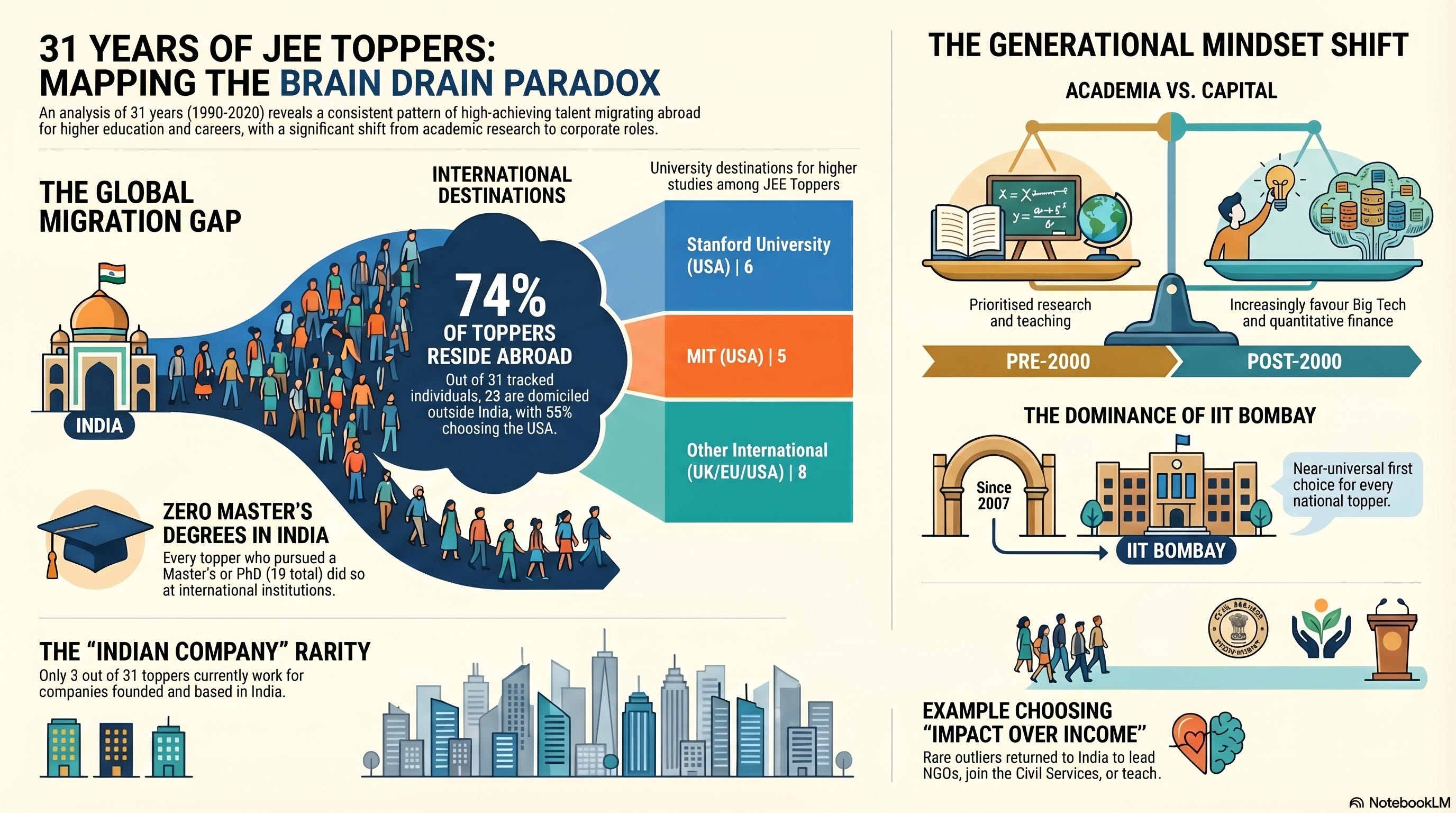
Anyway, so I then fed the tabular data to ChatGPT, and asked it to look for trends (I just feel more comfortable asking such questions to ChatGPT than to Notebook; I did ask Notebook for an infographic which I’ve inserted below).
Sharing those trends in this post.
-Amrit (Li, Insta, YT) // a short-bio on me
So these are the trends:
IIT CSE → US PhD → Academia / Research is a dominant track
Stanford + MIT are disproportionately influential
US is the default destination
Clear bifurcation: Research vs Money tracks
Recent trend shift: More direct-to-industry (fewer PhDs)
IIT Bombay dominates disproportionately
Dropout → MIT → Global success is a recurring micro-pattern
Very low entrepreneurship representation
India-return cases are purpose-driven (not money-driven)
CSE dominance is overwhelming
1. IIT CSE → US PhD → Academia / Research is a dominant track
A huge chunk follows a near-identical path:
IIT (mostly CSE)
→ Stanford / MIT / Princeton PhD
→ Professor / Research Scientist in the US
Examples: Sanjiv Arora, Subhash Khot, Kamesh Munagala
What this suggests:
IIT CSE acts as a feeder into top-tier US research ecosystems
Theoretical CS + Algorithms is a very strong export category from India
Stanford/MIT appear repeatedly as gateways
2. Stanford + MIT are disproportionately influential
If you map “post-IIT destinations”:
Stanford → recurring for CS PhDs
MIT → both direct (dropouts/transfers) and postgrad
Others (CMU, Princeton, UCSD) are secondary
Net, net you can say that these institutes act as global talent aggregation hubs, likely driven by:
Faculty networks
Alumni pipelines
Strong research alignment with IIT toppers
3. US is the default destination
Rough split (approx):
~70–80% USA
Small pockets in:
India (academia / consulting / public service)
Europe (ETH, CERN, Amsterdam)
Asia (HK, Korea)
For JEE toppers, India only seems to retain:
Academia (IIT Kanpur, TIFR)
Civil services
Some industry roles
4. Clear bifurcation: Research vs Money tracks
Two dominant career clusters emerge:
A. Research / Academia
Professors
OpenAI / Google Research
Theoretical CS, AI, math-heavy work
B. High-paying industry roles
Quant trading (Jane Street, Optiver)
Big Tech (Google, Microsoft)
Finance (Morgan Stanley)
Examples:
Quant: Pranav Goyal
AI: Sushant Sachdeva
If you really think about it, the same cognitive skillset splits into:
“Truth-seeking” (research)
“Money-maximizing” (quant/tech)
5. Recent trend shift: More direct-to-industry, fewer PhDs
Older cohorts (pre-2010):
Strong bias toward PhD → academia
Newer cohorts (post-2015):
More:
Quant trading
Startups / ML engineering
Direct industry roles
Examples: Aman Bansal, Sarvesh Mehtani
I guess over time, the opportunity cost of PhD has increased and industry (especially AI + quant) is now as intellectually rewarding + far more lucrative.
6. IIT Bombay dominates disproportionately
Possible reasons:
Stronger competitive culture in CSE
Better peer signaling
Alumni network effects
Higher concentration of “top rankers”
Can you think of more?
7. Dropout → MIT → Global success is a recurring micro-pattern
Examples: Chitraang Murdia, Satvat Jagwani
8. Very low entrepreneurship representation
Almost no founders (except 1–2 like Machineifi / NGO) became entrepreneurs.
May be this makes sense because A list of IIT toppers simply optimizes for: Exams → Research → Jobs, not for things like risk-taking or company building.
9. India-return cases are purpose-driven, not money-driven
People who stay/return to India:
Academia (IIT, TIFR)
Civil services
NGO
Example: Immadi Prudhvi Tej
So you can say that:
India = impact / stability / institutional roles
US = frontier work / money / scale
10. CSE dominance is overwhelming
Almost everyone is:
Computer Science
Or adjacent (Math, Bioinformatics, AI)
What is your one key takeaway, if any?