

In the IITM entrepreneur’s group on Whatsapp that I am a part of, someone shared Deepinder Goyal’s recent Twitter post with the following comment - “Fortune made from selling unhealthy food now being invested in longevity 🙃“

I thought (and shared in the group) that it was perhaps slightly unfair to refer to a delivery platform (where consumers can order what they want to) as an unhealthy food provider.
Though I acknowledged that Zomato (or Swiggy for that matter) has definitely enabled more eating of outside-food. And since outside-food in general is more unhealthy than healthy (both in terms of overall availability and what consumers tend to order), I do see his logic at the same time.
But I got a much better explanation from him.
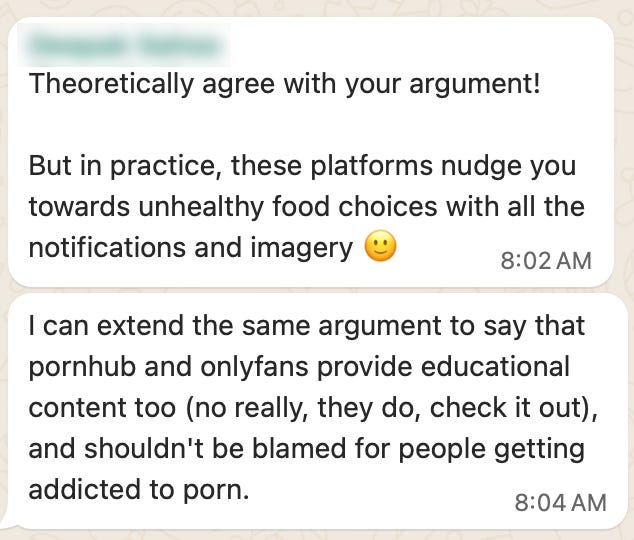
Very good point indeed.
Now this made me wonder how each of the three parties - the consumer, the distributor (or platform) and the product-maker can technically be blamed for unhealthy product consumption by the other parties.
And then I said to myself - could I apply the Indian mythology framework made popular by Devdutt Patnaik to explain this? The rest of the blog is exactly that.
Using Indian Mythology to explain guilt-avoidance reasoning of consumers, platforms and manufactures of unhealthy products
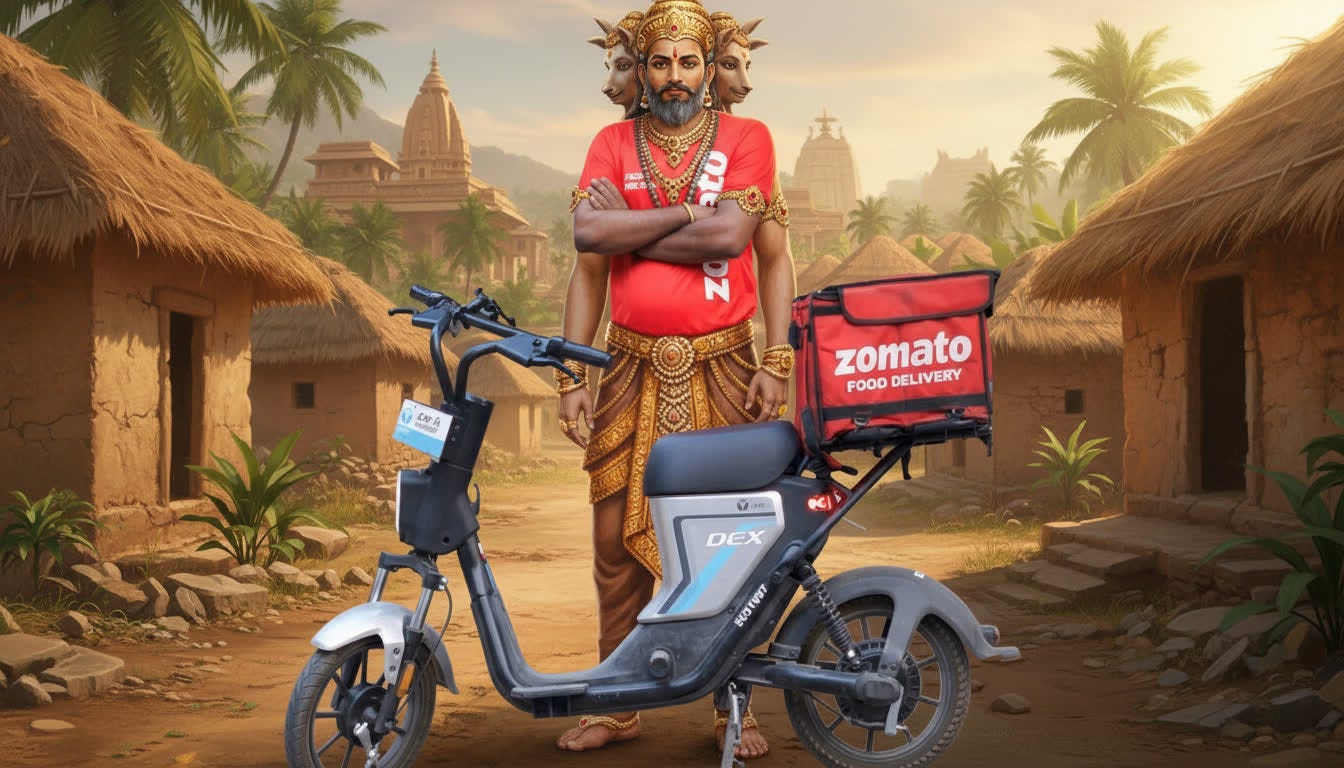
Essentially each party is justifying their actions by retreating into a limited subjective reality (brahmanda), where the business environment is a battleground (rana-bhoomi) rather than a happy playground (ranga-bhoomi).
1. The Maker (Producer) – The Pursuer of Lakshmi (The Indra Mindset)
The maker justifies their actions by claiming they are merely satisfying existing consumer desire: “This is what consumers want and this is what sells on platforms -so why should I not make this?”
From a mythological perspective, the Maker typically operates with the mindset of Indra, the King of Devas.
Hunger and Justification: The Maker is primarily driven by the hunger for Lakshmi (wealth/revenue) and seeks a high return on investment. Human hunger for resources is insatiable and expanded by imagination (Kama). The Maker sees themselves as simply capitalizing on this persistent hunger.
Avoiding Guilt: The Maker sees the product (e.g., cigarettes, unhealthy food, porn) as the necessary svaha (input / offering) to generate a proportional tathastu (output/revenue). By focusing on what sells (the measurable, tangible Narayani), they evade responsibility for the why (intent), often adopting rajas-guna, where they cling to their own opinion and see wealth as the primary target.
The Violence of Creation: Creating wealth often involves violence (bali), which is inherent in extraction and production processes. The Maker rationalizes that this violence (e.g., creating unhealthy products) is an unavoidable consequence of creating economic activity, much like the Devas defeating the Asuras to access wealth. As long as they are not the victims of the violence, they do not mind being the perpetrators.
2. The Distributor / Platform – The Compliant Follower (The Duryodhan / Daksha Mindset)
The distributor claims neutrality, viewing themselves as a passive conduit: “I am helping the product pass from one hand to another. Why should I be blamed?”
This position reflects a mindset obsessed with rules and procedure, seeking security rather than ownership.
Focus on Rules and Process: The Distributor acts like Daksha, who is obsessed with rules and sees the yagna merely as a process or duty. They operate as a karya-karta (one who follows the directive) rather than a proactive karta or responsible yajaman (initiator of exchange).
Avoiding Guilt: They operate with a focus on compliance, adopting the persona of Duryodhan, the “pretender” or “mimic” who follows the letter of the law but ignores its spirit. They use rules and systems to control the world around them and get their way. By sticking strictly to the rule that the products are legally permitted or follow platform guidelines, they encourage the organization to promote tamas-guna (mindlessly following the system). They avoid the burden of uncertainty and consequences associated with being a true yajaman.
The Pursuit of Durga: By strictly following protocol, the Distributor seeks Durga (power / security). They gain security by not rocking the boat, fearing that deviations (like refusing a legal, albeit harmful, product) would invite scrutiny or failure, thus maintaining their position in the social hierarchy.
3. The Consumer: Externalizing Responsibility and Seeking Validation (The Asura/Indra Victim Mindset)
The Consumer absolves their guilt by focusing on the external factors that led to their choice: “I consume because it’s being marketed and legal and is available to me easily.”
The consumer operates as a devata (receiver of the transaction) whose hunger, amplified by imagination (Kama), leads to continuous craving. They see themselves as the victim of Seduction (Kama) and Maya (Delusion), denying their own accountability (karma).
From a consumer’s POV, marketing and advertising seduce them by creating irresistible cravings. Imagination (Kama) expands human hunger, making it insatiable, even for harmful products. They are convinced by the delusions (maya) of advertising, which code intangible thoughts (status, power) into things.
Consumers also expect Sanskriti (society/rules) to protect them by only providing things that are “good”. By blaming the law/regulators for allowing the product to exist, they externalize their failure to exercise internal wisdom (Saraswati) and claim they were denied Durga (security) by the system.
So if you really think about it, the consumer can always frame the entire exchange as an external phenomenon, resisting the idea that they are a karta (responsible decision-maker) and instead acting as a reluctant devata or a victim of circumstances. They can refuse to see themselves as the villain, only as a hero or martyr within their subjective reality (brahmanda).
Could there be a consolidated view here? The Vishnu Gaze perhaps?
If you think about it, this constant cycle of guilt avoidance and conflict (the rana-bhoomi) essentially persists because all parties prioritize chasing measurable wealth (Narayani) and external power over intellectual and emotional growth (Narayan/Saraswati).
So may be below is for all of to consider:
Accepting Karma: True accountability, or dharma, is achieved when humans realize that every experience is a consequence (karma) of their own conduct, and blaming others is not an option.
The Dependable Yajaman (Vishnu): Vishnu (the preserver) is the embodiment of the leader who outgrows his own hunger and is consumed by other people’s hunger. He recognizes that the yagna is an exchange of Lakshmi, Durga, and Saraswati.
Upliftment (Uddhar): Vishnu descends (avatarana) to prompt uddhar (upliftment of thought), encouraging Brahma’s fearful sons (like the Maker and Distributor/Platform) to expand their gaze. Growth happens when the yajaman makes the devata’s growth an outcome of his own, investing in others’ growth so that the return is mutual growth.
The Value of Intent: In the Indian framework, what matters is the reason why rules are followed or broken, or why actions are taken, not just the action itself. When the parties stop being frightened and expand their gaze, they move towards mutual growth and ethical conduct.
Alright, this is all that I had to share. Would really like to know your take / opinion / views - if you can drop them in the comment. See you later. Let me quickly order some veg-pakoda now. :D