

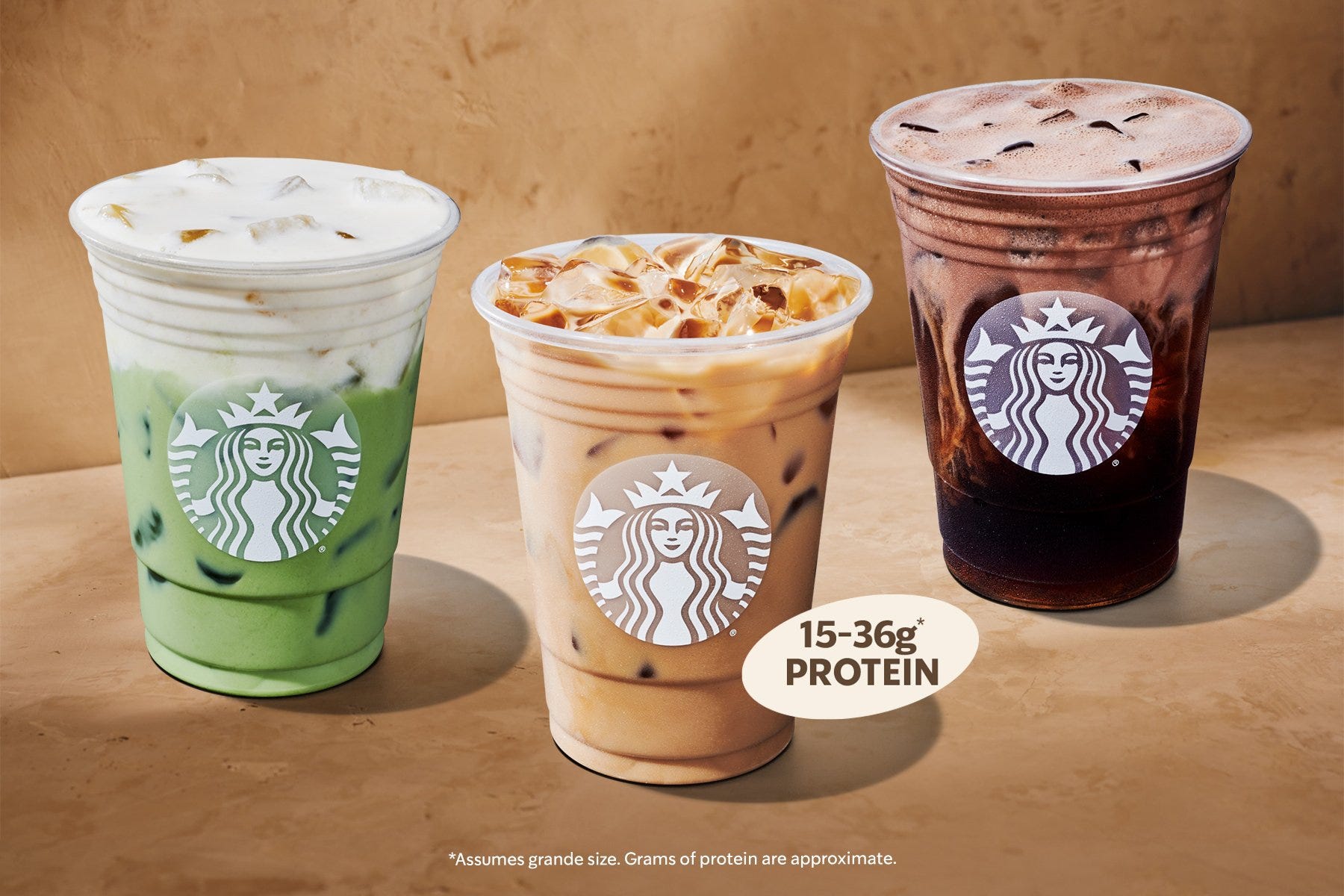
I read recently that Starbucks will soon be launching Protein Lattes (source). Everybody is launching protein something it seems.
This news reminded me to write about the findings of a paper from last year that had explored the correlation (and causation) of Starbucks on entrepreneurship (US).
Before that, let me quickly share some interesting stuff from another paper that tries to answer a protein related question:
Is 5gm of protein > Five grams of protein?
Yes.
Apparently, consumers perceive numerical information presented in digits (say ‘5’) as feeling more right and correct than the same information presented in number words (“five”).
There is a name for this phenomenon: “number format effect” (here’s the full paper published this year).

Participants were shown advertisements for various products, including a protein shake. Those who saw the advertisement with the digit (”5 Grams of Protein”) reported that the ad felt significantly more “right” compared to those who saw the ad with the number word (”Five Grams of Protein”).
What explains this?
Well, digits just happen to be the ‘norm’ when it comes to communicating numerical information - so when consumers see digits, they perceive it as the correct format, which creates a positive feeling. This positive “feeling of rightness” basically enhances their judgments and affects their behaviour.
Alright, now to the entrepreneurship study. It’s way more interesting than this digit gyan, I promise.
Starbucks → Entrepreneurship?
In the world of urban economics and sociology, there’s a long-held idea that places outside of home and work - cafés, pubs, and restaurants - are vital for community life. Three researchers, Jinkyong Choi, Jorge Guzman, and Mario L. Small, wanted to know if this idea stretched beyond social well-being into the realm of economic creation. And so, they decided to study Starbucks.
Since the 1980s, Starbucks had intentionally built its entire brand around the concept of the “third place” - a social setting for people to gather, relax, and talk, inspired by European cafés. This made it the perfect test case. The researchers’ plan was to look at data on all new business registrations across the United States from 1990 to 2022 and see if the number of startups went up in a neighbourhood after a Starbucks opened its doors for the first time.
But of course, a simple comparison would be misleading. Does a Starbucks cause a neighbourhood to thrive, or does Starbucks simply choose neighbourhoods that are already on the upswing?
The researchers came up with a clever way to isolate the “Starbucks Effect” from the company’s real estate strategy.
First, they hunted for a natural control group: neighbourhoods where Starbucks planned to open a café, but was ultimately rejected due to local issues like zoning board denials or community protests.
They found 13 such cases, in places like Missoula, Montana, and San Francisco, California. These “rejected” tracts were a perfect mirror image of the treated ones, because Starbucks itself had deemed them worthy of investment.
When they compared these rejected neighbourhoods to similar ones that did get a Starbucks, they found a clear signal…
The arrival of a physical Starbucks increased the number of new local businesses by anywhere between 9% to 18% over the next seven years.
In comparison, the mere plan to open one had no effect.
Their second approach brought in an unexpected hero: Earvin “Magic” Johnson. In 1998, the basketball legend had partnered with Starbucks to form “Urban Coffee Opportunities,” a venture designed to bring cafés to under-resourced, minority neighbourhoods like Harlem in New York City and Ladera Heights in Los Angeles. These were places Starbucks hadn’t previously considered, which helped reduce the bias of the company’s typical site selection. The stakes here were high, as Johnson argued these cafés would be an “anchor to attract other businesses”. Therefore, by analysing the 65 Magic Johnson locations they identified, the researchers discovered an even more dramatic result: these cafés boosted local startups by a massive 29.7% per year, or about 4.3 new firms annually. So basically the effect was largest where such community spaces were needed the most.
The researchers’ final plan was to zoom out and look at the big picture. They identified 3,970 census tracts across the U.S. that had no coffee shops at all before a Starbucks arrived between 1997 and 2021. Comparing these to neighbourhoods that remained coffee-shop-free, they again saw a clear pattern. The data confirmed their hypothesis on a massive scale…
Getting a Starbucks as a first-ever café led to a 5.5% to 13.6% increase in new startups, equivalent to about 1 to 3 additional firms each year for at least seven years.
But what explains these results?
Was Starbucks a “signal” to investors that a neighbourhood was a good bet, like a lighthouse guiding ships to a safe harbour? Or was it fostering “networks,” acting as a trellis upon which local entrepreneurs could grow their ideas through conversation and connection?
If it was about signalling, they’d expect to see a surge in real estate firms and other retail stores.
But they found no such evidence.
In fact, they also found that…
Chains like Dunkin’ Donuts, which focus on quick service rather than lingering, had no effect on entrepreneurship, whereas Caribou Coffee, which shares the “third place” model, did.
The effect also decayed rapidly with distance - it was a quarter of its original size just 1-2 kilometres away - which is exactly what you’d expect from face-to-face networking, not a broad economic signal.
Finally, they found that larger Starbucks cafés with more foot traffic had a much bigger impact.
All this pretty much points to the following explanation for how the ‘causation’ occurs: a Starbucks café, by creating a “third place,” helps local entrepreneurs form and mobilise the connections they need to brainstorm, find support, and turn an idea into a registered business.
The Struggle
It’s also in the news that the chain is having some issues. The total no. of stores in North America may go down by 1% this year (some major ‘restructuring’ unfolding).
I got curious and asked ChatGPT to find out the total store number (globally) over the last few years.
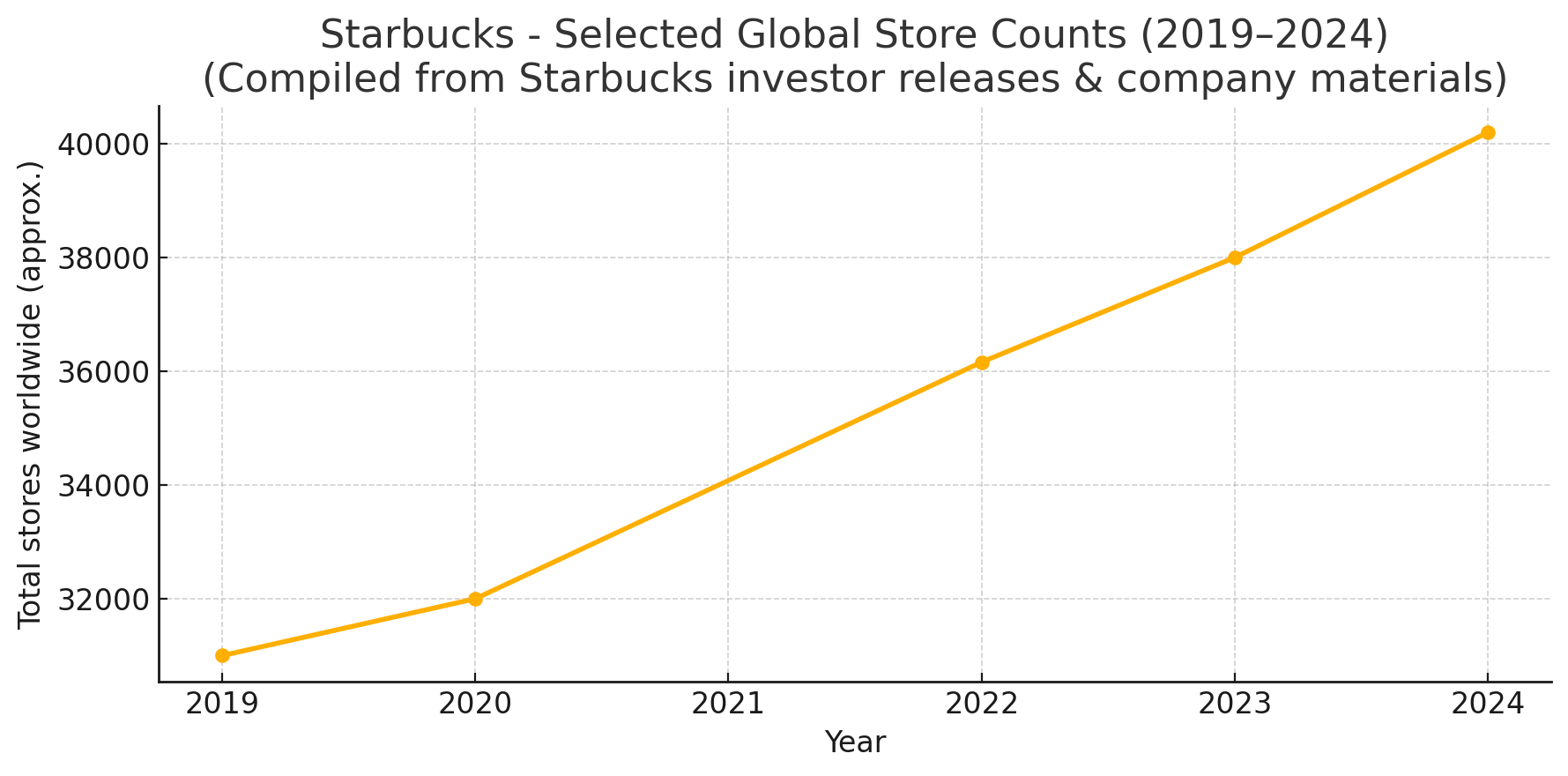
The line looks pretty linear TBH.
What about India though? I wondered. Same story - ChatGPT showed me. Stores have been growing in number, pretty much linearly.
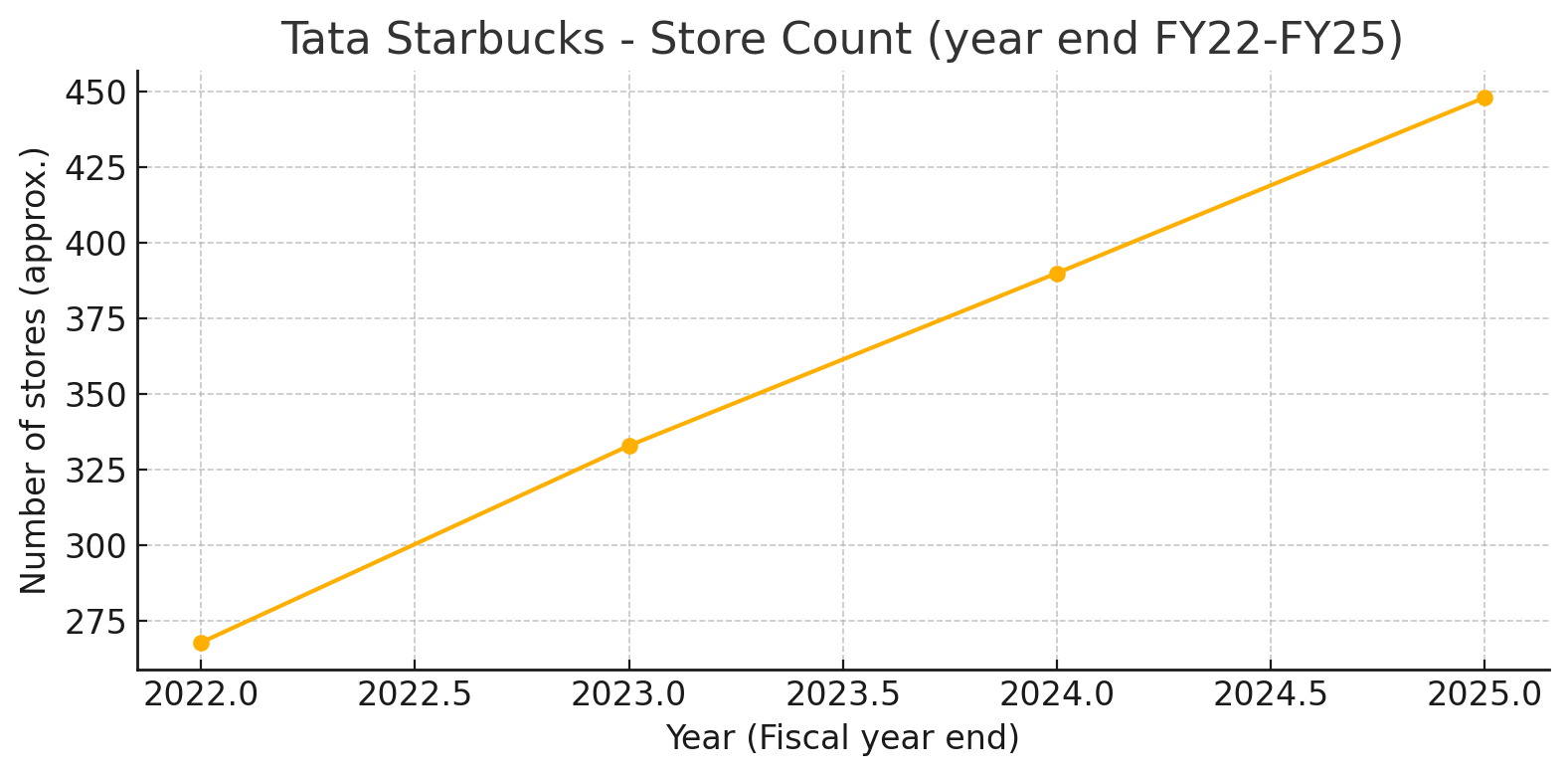
By the way, if you notice the above two charts, you will see that India accounts for only like ~1% of total no of stores (~400 vs ~40,000).
Anyway, there is another cool graph that I saw in a newsletter that I think is very interesting to look at - so sharing below.
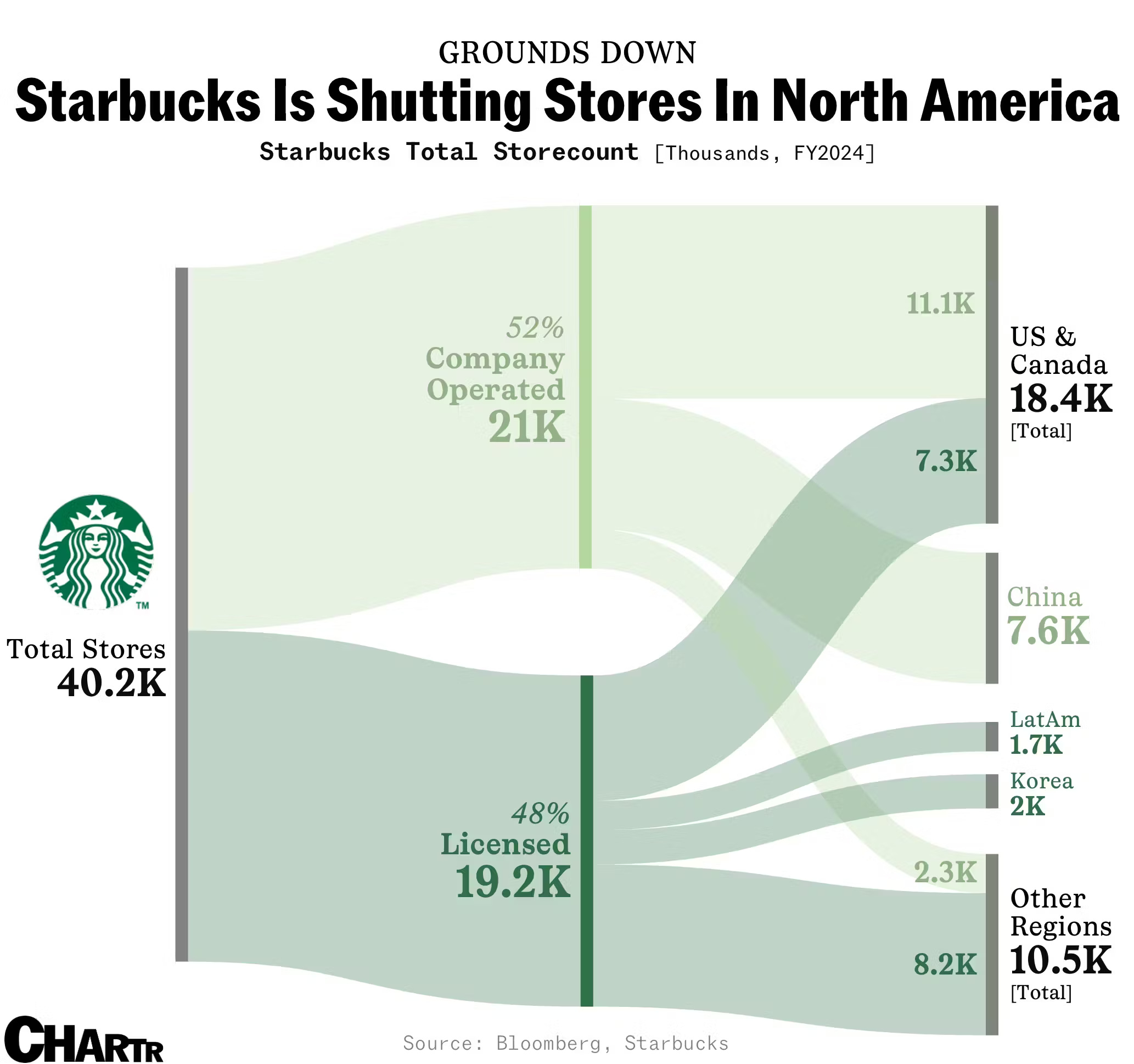
Ok now I am just throwing random data at you, without knowing what to do with it. Let me quickly wrap up this blog by bringing back some India numbers (thank you ChatGPT).
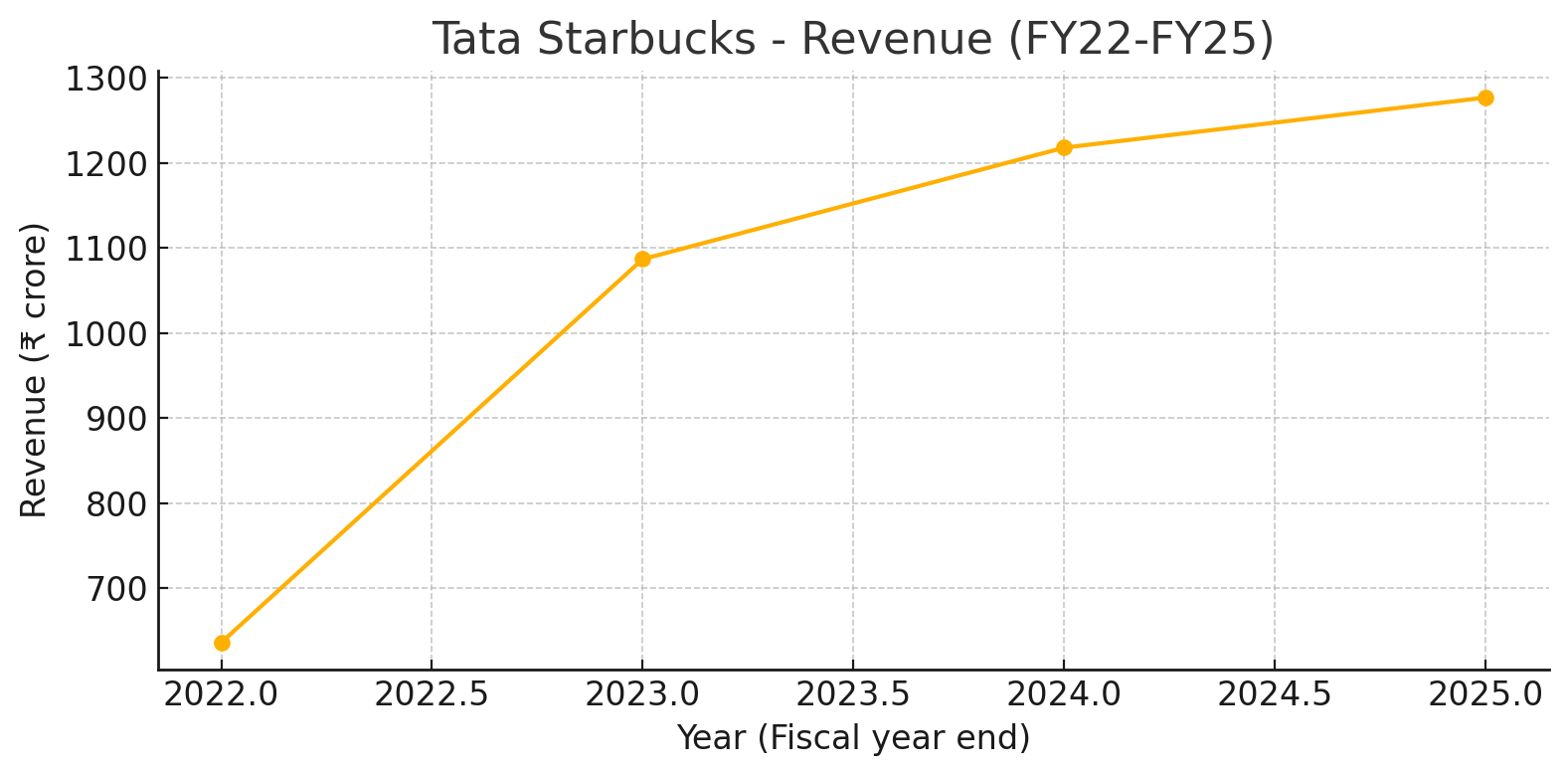
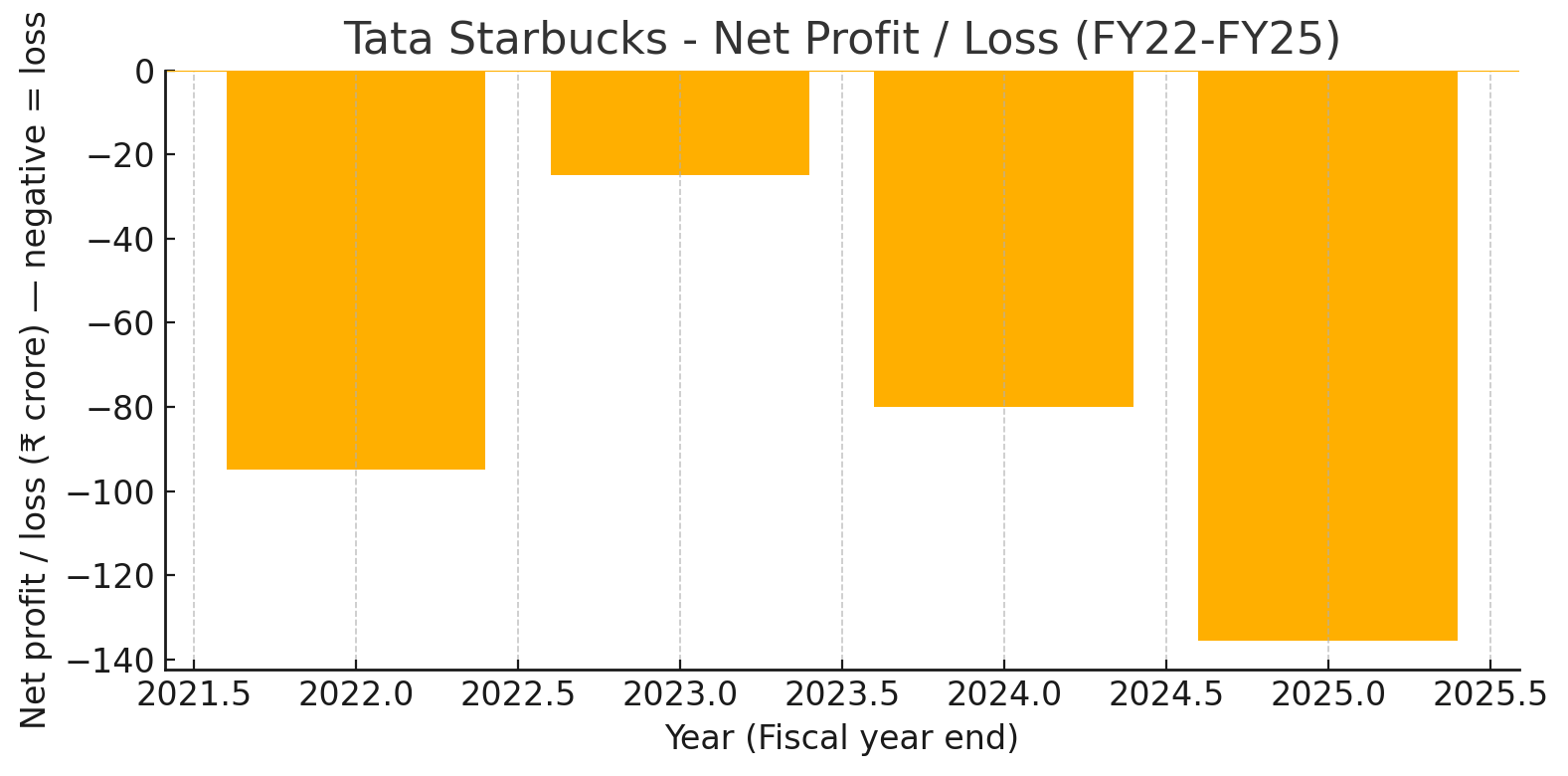
Not sure why ChatGPT chose to add .0 to year but that’s for another time. Time to end this now. I can only hope and wish that protein lattes help Starbucks see some good results - both globally and in India. And I hope you get to have some good coffee, with or without protein. See you soon!