

I grew up in a house a hundred meters away from Lal Babu Market in Patna.
It’s not a famous market or anything. In fact, nobody from Patna would know of it unless they grew up around it too. It was just a building (still is) with a series of shops on the ground floor, starting with a barber shop on the left and ending with DK’s samosa shop on the right. Over the years, the barbers kept changing, though DK continued to run his samosa shop for as long as I remember.
Between the barber shop and DK, there was a video-cassette shop, at least two kirana stores, probably one stationery shop and a bunch of more. The owners, they all lived in the same colony. And almost nobody was in this business because they wanted to.
Being a ‘shopkeeper’ was not the most respectable thing to do (and maybe that hasn’t changed even today). It was something you did if you couldn’t get a job—primarily a government job back then. You would be hard-pressed to find anyone in Patna who cleared an exam, secured a government job, and then chose to become an ‘entrepreneur’ by opening a shop.
Job vs Own Business
When you take up a job, you are essentially entering a system set up by someone else. The system meets you where you are and takes you on a journey. If you leave the system, someone else will be found to replace you.
The system doesn’t need you per se. It just needs someone to execute a bunch of tasks so that, in the end, more money is generated than is needed to pay the people working as part of the system. And today, one option for that “someone” is an AI agent. Which is perhaps why systems across the world seem to be reconfiguring themselves, as we speak.
But when it comes to starting and running your own business (and if you are aspirational, then also growing it) - that requires a fundamentally different set of skills and, more importantly, a different attitude than what is needed as an employee.
To be an entrepreneur, you need to know how to sell and deliver.
You need to build and set up your own systems. You ask for help. You learn. You make mistakes. And struggle a lot because the path is just not that well defined. Plus there is competition and external circumstances to deal with.
The culture of white-collar employees leaving the job ecosystem to become entrepreneurs (out of choice) started gathering momentum around the time I graduated from IIT Madras with a dual degree in 2008.
Ninety-nine percent of my batchmates either took up a job or went for higher studies—that’s my guesstimate.
A very, very small percentage chose to do their own thing, and there too, mostly because they had a family business. In fact, I captured some of this in a film I made a few years ago.
But over the years, more and more white-collar workers started leaving their jobs to start up. Or just freelance, like I did when I first took a break from my corporate job as a management consultant.
“If you look at the reasons for becoming an entrepreneur, there’s a book called Founders at Work, where over thirty successful founders share their journeys,” Ashish tells me. He volunteered to speak with me on this topic after I put out a public post on LinkedIn. A few others reached out too, and I will quote some of them later in this essay.
Ashish runs a zero-to-one community of founders, so he spends his days talking to people who are trying to figure out how to survive outside the system.
I looked up the book he recommended. From there, I have listed down the various reasons why someone chooses entrepreneurship—as an annexure towards the end of this article (if you’d like to read).
Anyway, so that brings me to the main question that I have been asking myself lately.
The way AI has started reshaping the world’s economic structure—would it force more white-collar employees to become entrepreneurs?
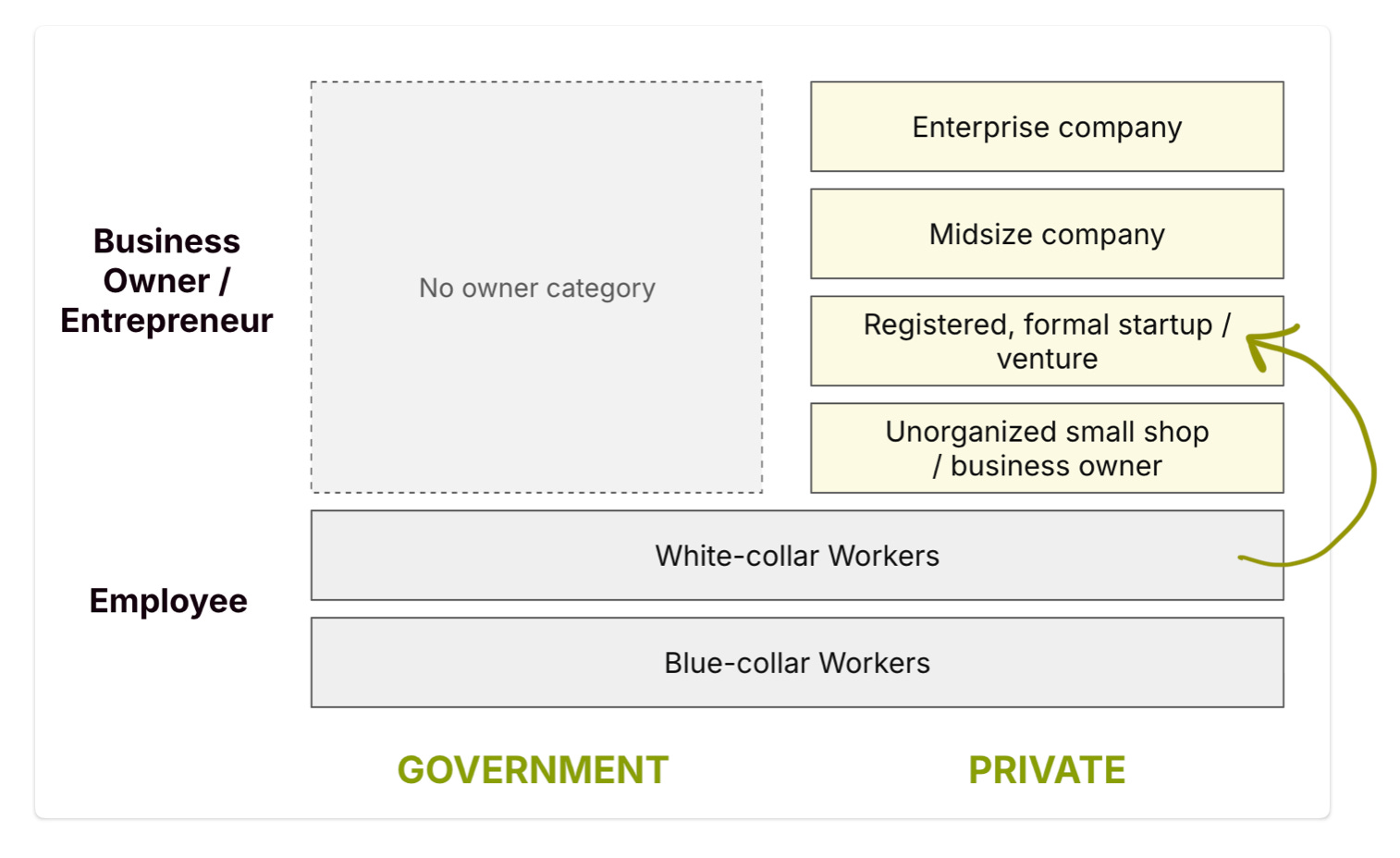
I am basically talking about the arrow in the above diagram.
"My transition - from job to trying to do my own thing - wasn't driven by AI," Harsh tells me.
Harsh and I studied together in XI-XII in Ranchi (same school as Dhoni’s). He now lives in the US and is building something for the maritime industry.
After spending many years in the maritime supply chain and operations, earning a master’s at MIT, and working deeply across technical and commercial management, at one point he realized that the time was right for him to do his own thing. He wanted more autonomy and he had enough savings and no liability. So he left his job.
But he agrees with me on why businesses may need less employees today. “If AI allows a business to deliver the same output—or a hundred times more output—with a fraction of the staff, they will absolutely take that route”, he says.
Ashish is not very convinced with this take. “Take the massive IT service giants in India—the TCS’, Wipro’s, and Infosys’ of the world. You hear their executives talking about AI enablement and digital transformation, and you assume mass automation is already happening,” Ashish says dismissively. And then he tells me that these legacy corporations simply lack the caliber, organizational structure, and basic capability for that kind of genuine innovation.
So why are they constantly talking about AI? “It is just a share price game.”
Now what about the person who lost his / her job to AI? Can the same AI also help them become an entrepreneur? I had argued earlier that entrepreneurship requires two broad capabilities: the ability to sell and the ability to deliver. But perhaps AI changes that equation. Perhaps it allows people to compensate for the skills they lack and amplify the ones they already possess.
“AI has fundamentally lowered the cost of intelligence, creating a massive decentralization effect,” Harsh says, aligning with this broader thesis. “Almost everyone will become a company unto himself or herself.”
If that is true, are we moving away from a world dominated by large, centralized companies towards one filled with millions of highly personalized, small-scale businesses? And if so, is this simply a new version of the kirana model—not for groceries, but for skills? A world where white-collar professionals run tiny, AI-powered enterprises, serving niche needs with remarkable efficiency.
Arjav, a young IIT graduate, recently moved out of Surat to start working from the hills.
He left his job and wanted a remote role. He spent months applying to startups, but kept running into founders who expected one person to do the work of an entire department. After a point, he stopped looking. Instead, he figured out freelancing—using AI to create web apps, build workflows, and generate content.
“I am not dependent on anyone else,” Arjav tells me.
“Because of AI, I’m able to create workflows and take a creative direction that was not possible before.” He shared that he was able to reach his last corporate income level within a few months, gaining total autonomy over his time.
When the technical barrier to execute an idea disappears, you don’t need a massive system behind you. You can sell and deliver your service directly.
But having the tools to build a business is not the same as surviving as a business.
“I think many people are jumping into entrepreneurship purely because of the AI hype,” Ashish remarks.
“They string together fifteen AI agents for sales, lead generation, and marketing, expecting to sit back and collect cash. But there is a massive failure rate because they don’t understand their financial runway. They don’t know how to survive long enough to just be ramen profitable,” Ashish adds.
AI can draft a perfect sales email. It can automate your accounting. But can it give you the psychological endurance to handle a hundred rejections in a row? And if not, can you really become an entrepreneur if that’s not who you really are at heart?
Simran, who runs a B2B digital agency, has seen this firsthand. Her entry into entrepreneurship was less of a choice, and more a way to survive. Years ago, her dad slipped into a coma, and she and her brother had to figure out how to make money immediately. She knows the grind.
She shared with me the story of one of her operations heads who quit to start her own SaaS venture. “I told her that she still needed to know how to sell and handle the gruelling parts of a business,” Simran recalls. Two months later, the girl called back asking for her old job.
“Not everyone has the thick skin for entrepreneurship,” she sums up.
Anyway, one way or another, something tells me we are stepping into a strange phase. People who prefer the structure of employment—who want to focus on doing good work without the anxiety of hunting for the next paycheck—will still want jobs. But as corporate systems automate and shrink, those safe jobs might become harder and harder to find. And maybe these folks will never thrive as entrepreneurs. But I hope that with AI, they can at least survive.
PS: Lal Babu Market - extracted from Google Street View.

Annexure: Why people become entrepreneurs
Summarized from the book Founders at Work.
Solving a personal problem - out of necessity by building a tool or service that didn’t previously exist
Desiring financial independence and the high-reward upside of stock options instead of steady employment
Refusing to work for someone else and wanting the autonomy to dictate one’s own terms and avoid undesirable office jobs
Wanting to change the world and leave a lasting legacy by creating something that benefits humanity
Taking pride in craftsmanship and wanting to build a genuinely great product without the interference of corporate bureaucracy
Growing a hobby or side project that unexpectedly gained massive traction and naturally morphed into a viable business
Following in the footsteps of entrepreneurial parents, which makes starting a company feel like a normal career choice
Seeking recognition or fame, using great design as a way to get noticed, especially for founders who are naturally shy
Helping out a community by providing a service that connects people or assists them in their daily lives
Avoiding tedious or undesirable tasks, such as starting a web-based company simply to avoid having to learn Windows programming
Recession - creating a job opportunity during an economic recession when traditional employment is difficult to find