

Den (name changed) is a senior from IIT and has decades of marketing experience. We had a call today morning where he wanted to share some thoughts that were running on his mind.
He’d been watching some videos from the Jantar Mantar protests, and they had set off a chain of thought in him. His conclusion was that Indians don’t hold the country in high esteem because we don’t see it as a “fit” the way, say, an Apple employee sees their company as a fit. And this absence of pride shows up everywhere - he explained - from littered roads to broken rules.
It’s a lack of pride that makes one carve “I love you” into an ASI structure, was his point of view. And he wanted to know my thoughts on using storytelling to fix this problem our nation seems to have. Stories of real people doing real things, not manufactured nationalism (that our news anchors do 24X7).
This reminded me of a story on Arvind Gupta that I had done about a decade ago, when he had not yet won the Padma Shri (I changed the thumbnail later).
And I think many more stories like this already exist. In fact, if you just consider the overall theme of ‘pride’, every mainstream news channel is technically telling you to feel proud of your country. If anything, the supply is enormous.
Nationalism vs Patriotism
George Orwell offered one of the most influential distinctions between patriotism and nationalism in his 1945 (essay).
Patriotism is devotion to a place and a way of life, without wanting to force it on anyone else. It’s defensive, not competitive.
Nationalism, on the other hand, is the version where you start ranking your nation against others. This is when your own identity gets fused so tightly with the country that any criticism of the nation feels like criticism of you personally.
Diving deeper, in a series of studies published in 1999, political psychologists studied what they called blind versus constructive patriotism:
Blind patriotism means unquestioning positive evaluation of your country, staunch allegiance, and no tolerance for criticism of it (now you know where andhbhakti originates from)
Constructive patriotism means you’re attached to the country too, but you support questioning and criticising its practices because you want it to actually get better.
I don’t see what the kids at Jantar Mantar had to do or say as a lack of pride. They are patriots. They care about their country. And they are doing what they can just so that their voices can be heard. If what it takes to be heard is to protest, give gaalis to a shrewd politician and make memes about him and his party, so be it.
But obviously if you end up fusing your identity with the nation, anything that complicates the nation’s image begins to feel like a threat to you.
Den insisted he wasn’t in the “nationalism for nationalism’s sake” camp. I believe him. But the storytelling instinct he described - pick real heroes, celebrate what’s genuinely world-class, skip the messy parts - is also pretty much how a well-meaning constructive impulse can slowly move closer to the andhbhakti kind.
The problem is less with celebrating real heroes but when as part of the narrative, failures are consistently edited out and criticism starts being treated as ‘betrayal’. Selective celebration, done consistently enough, can start to function like unquestioning loyalty. Even when you don’t start it that way.
People Who Report More National Pride Also Tend to Report Greater Personal Life Satisfaction
In fact, research in this area shows that this relationship holds even after accounting for things like income, education, employment, marital status, where people live and the wealth of their country.
But there’s a small nuance. It matters what exactly you are proud of.
In the 2011 paper Subjective Well-Being and National Satisfaction: Taking Seriously the “Proud of What?” Question, researchers looked into what exactly people meant by national belonging. They measured two separate ideas:
Civic nationalism is the belief that respecting the country’s laws and political institutions is important to being considered a true national.
Ethnic nationalism is the belief that having the country’s ancestry is important to being considered a true national.
These are not opposite ends of one spectrum. A person can believe in both, one, or neither. And irrespective of which of these beliefs people held, one of the main findings was: greater national pride is associated with increased life satisfaction.
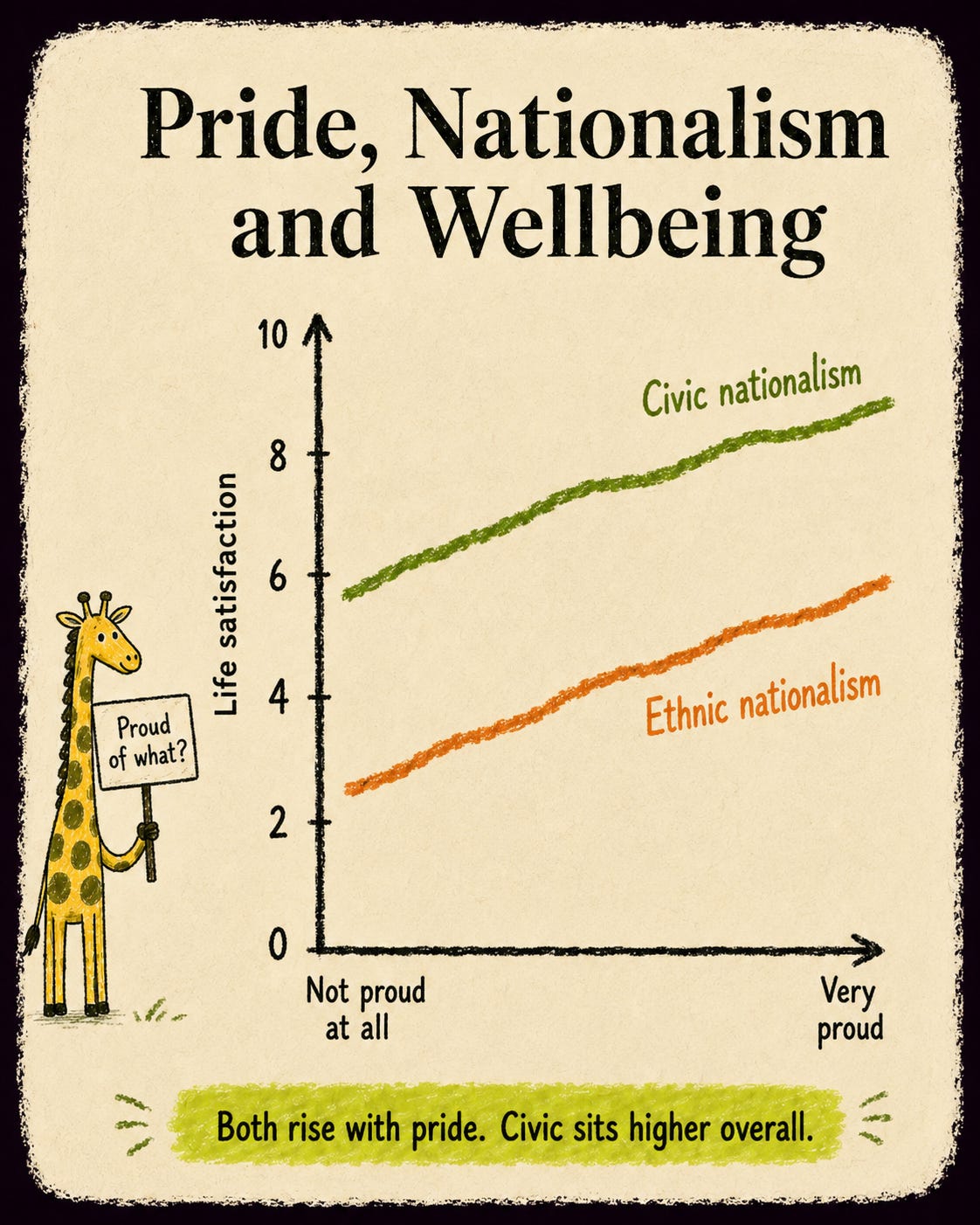
The nuance? Civic nationalism is associated with a higher level of wellbeing overall, while ethnic nationalism is associated with a lower one.
Proud civic nationalists are the happiest group. And non-proud ethnic nationalists are the least happy. In fact, even the proudest ethnic nationalists are only slightly more satisfied with life than the least-proud civic nationalists.
What Den was describing sounds closer to pride in collective achievement. And while that kind of pride can be perfectly healthy, it can also quickly become blind, depending on whether the storytelling leaves room for criticism, complexity and equal belonging.
Respect is easier to sustain when institutions repeatedly earn it. Whether our courts work. Whether the rules apply to everyone. Whether institutions do roughly what they say they’ll do.
And I think this boring civic stuff probably matters more to durable pride than another story, telling us that someone from India did something impressive.
By the way, one can take national pride and still think like a world citizen. In fact, a more recent research on national identity, global identity and life satisfaction found that people who reported both strong national pride and a strong sense of being a world citizen, also reported the highest estimated life satisfaction. The two don’t necessarily have to cancel each other out.
Coming Back to Storytelling
I don’t think storytelling is useless here. But it will only matter if feeling follows the substance, not the other way around.
If institutions work, pride is more likely to show up as a side effect. If they don’t, I don’t think any amount of well-shot documentary about a determined scientist is going to hold that feeling in place for long. Unless you build an authoritarian information system capable of suppressing every competing account.
So maybe the actual behavioural-change lever isn’t a story about a hero, but something much narrower and less cinematic than that: does the water connection get fixed in a week or three months? Does the FIR get filed without a bribe? Does the government website actually work? Does the person at the counter treat you like a citizen or like an inconvenience?
Although I can claim from my experience of having made hundreds of 3MinuteStories, that’s not a story many people share or consume. The pro-government lobby almost always over-markets everything and goes completely silent on the failures. And the anti-government group and activists can sometimes see it as pointless, or even dangerous, to acknowledge anything good happening in their country. And so a narrative or story that fuels either of these sides simply performs better. The success of Dhurandhar on one side and the anti-government, meme-fuelled CJP protests on the other, probably illustrate this.
Anyway, I don’t think I have a 100% clean answer for Den yet. I told him I’d think about it more, and I still am. Feel free to add your own commentary to this blog.
— Amrit
If you are a new subscriber, here’s my short bio. Think of this newsletter as a means to be in touch with a curious friend who is still figuring out life. And if you are in the same boat as me, hello friend - we will figure it out!


