

Was nice to witness a drizzle yesterday morning (see the video). I love rains. I got all excited.
Anyway, most of this blog isn’t about rain. It’s about a conversation on storytelling that I had the day before.
-Amrit, Founder - Story99 (here’s a short bio on me)
Someone a year or two senior to me in college (IIT Madras) reached out last week. She wanted to get some insights around a specific type of storytelling that I do - simplifying deeptech research (“Techtalk”). We finally spoke Monday morning.
D shared that she had recently left her corporate job at Unilever and is now exploring building a business around “storytelling training” - specifically for science and tech professionals.
I am recounting here some of the thoughts that came to my mind - as we spoke.
I realized that my dataset - the professors I usually interact with as part of my Techtalk series - is likely biased.
I deal almost exclusively with a top-quartile cohort of professors who have already successfully published papers and secured funding.
Which means there may very well be a cohort of faculty out there who are genuinely struggling to get their grants approved, possibly due to poor storytelling skills. They are simply invisible to me. I don’t know how large (or small) this pool is. Could they benefit from storytelling training? Yes. But there is a nuance here - and that becomes clearer if one thinks through the functional use-case of storytelling for an IIT professor.
A point that D made during our call was: “Many researchers possess the potential to share their work beautifully but are held back by a lack of access to communication tools.”
Now while ‘sharing one’s work beautifully’ is certainly one application of storytelling, I think there are many more - from a faculty’s point of view:
Research funding: to secure grants for their research
Admin-ladder: rising to positions like department heads, deans, directors, etc. (for those who prefer this route)
Startups: to launch startups (a small %age but they are there)
Teaching: teaching better in class (this too might be a smaller percentage)
There could be more applications. I could think of only these.
Anyway, so while improved storytelling should help across all of the above, the frequency with which one gets to practice storytelling varies depending on where it is applied.
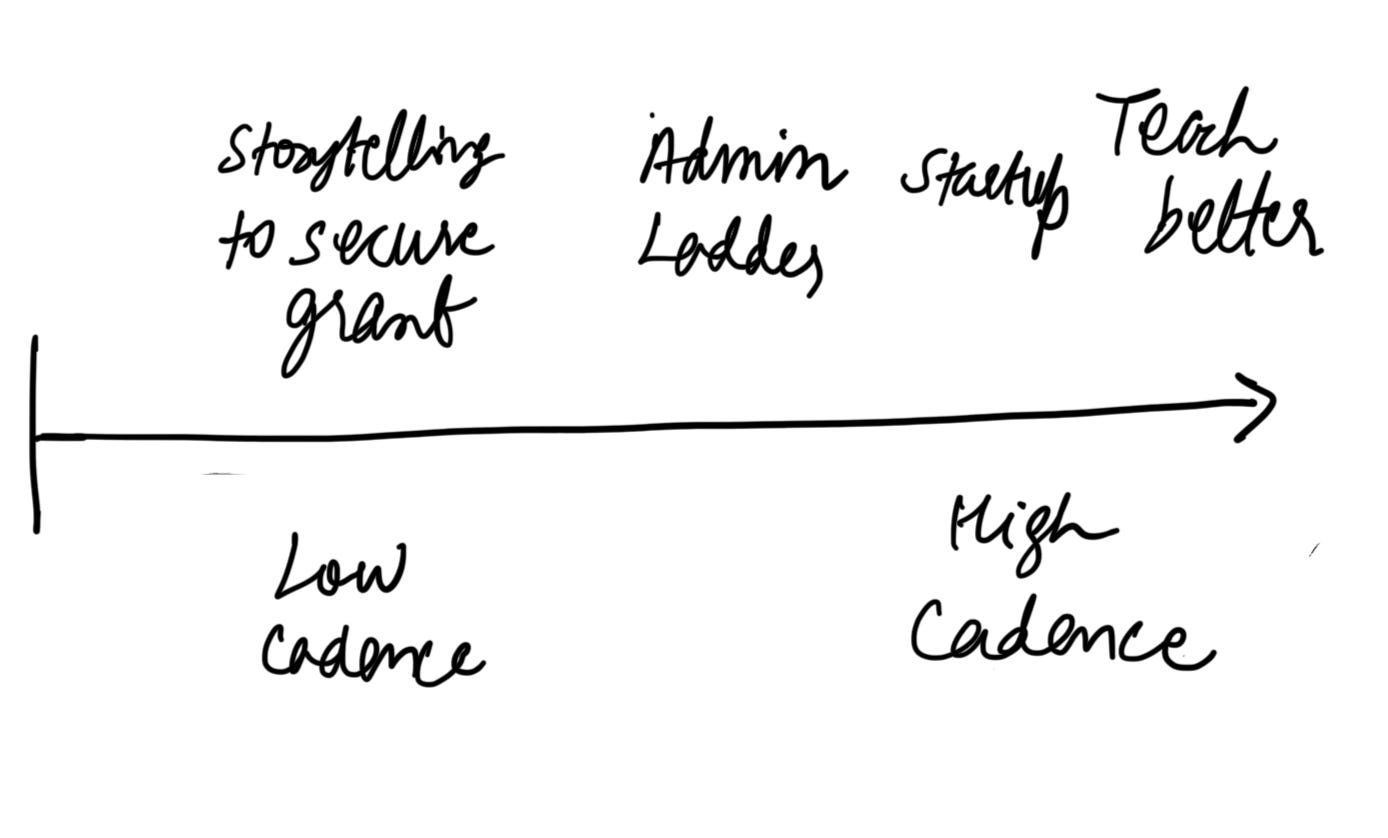
For example, if your primary goal is to raise grants, you don’t have to tell stories that frequently. But if you really love teaching, then you get to practice storytelling literally in every class.
Why does this matter? Because a training program can last only so long. For meaningful improvement, the trainee (the faculty, in this case) needs to be in an environment where they can practice the skill regularly. Otherwise, the gains may not sustain.
D mentioned how she wasn’t a great storyteller early on but developed the skill over years in her corporate career. That journey inspired her to help others build this ‘trainable’ skill. My point, however, is that some roles naturally allow for more frequent practice than others - and that creates a challenge.
I also look at it this way: even if you democratize storytelling training and raise the overall baseline of communication skills across an institute, the naturally ambitious and communicative professors (who were better storytellers to begin with) will likely maintain their relative advantage.
This is because most storytelling applications (as listed above) operate in a zero-sum environment.
There is only so much of research funding available
There are only so many admin positions
Only a fration of startups will succeed
Teaching is probably the only application here that is not zero-sum. If every professor became a better storyteller in the classroom, every student would benefit. But I suspect teaching is not the most sought-after use-case for many faculty members. For many, it is perhaps a good-to-have, not a primary pursuit.
Anyway, I wished D the very best in her new journey. I agree that storytelling can be taught - and even if it doesn’t benefit everyone equally, a world with more deeptech researchers who can tell better stories is certainly better than one with fewer.
-Amrit, Founder - Story99 (here’s a short bio on me)


