Just before I left Goa, I saw a Times of India headline saying 70 people had died this monsoon season in Himachal because of landslides, flash floods and other rain-related incidents.
Excellent timing.
Anshuman was flying in from Bangalore. I was flying from Goa. We were supposed to meet at Chandigarh airport and then drive about four and a half hours into the mountains. On the ground, thankfully, things looked fairly normal. So we went.
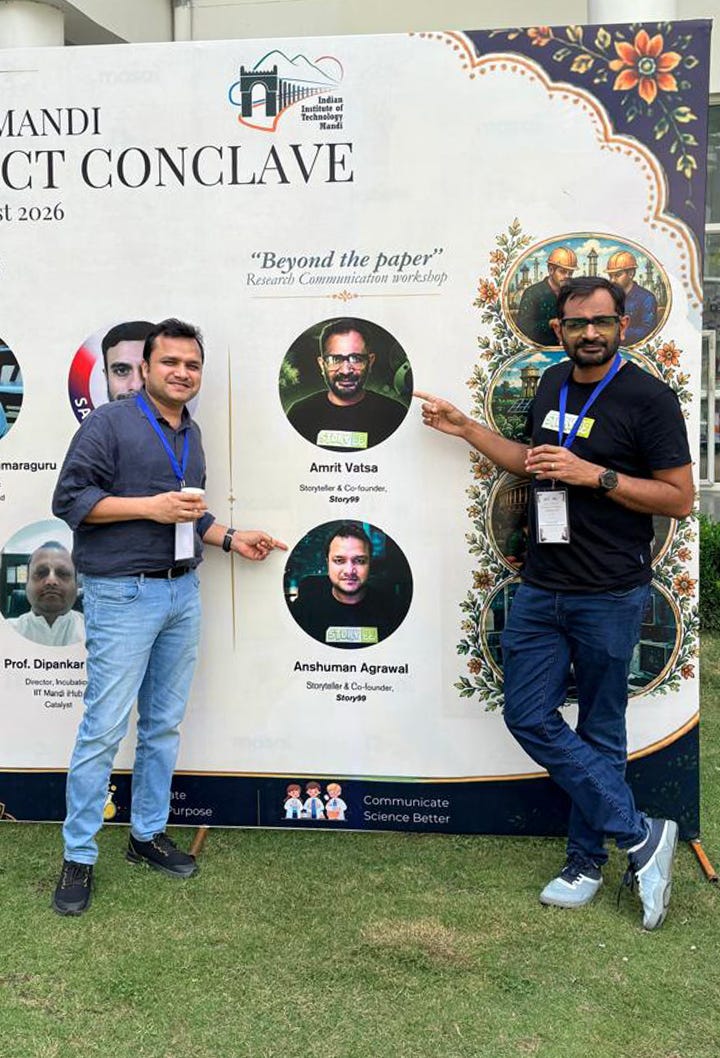
Anshuman and I were headed to IIT Mandi to run a workshop for about 50 professors, researchers and PhD students who had come from institutions across India. The subject was storytelling and research communication. Which is slightly funny because researchers already spend a large part of their lives communicating their research. They write papers. They make presentations. They defend theses. They speak at conferences. The problem begins when the person listening is not from their exact field. And that turns out to be most people.
There was a larger reason for this workshop.
ANRF, the central research funding body, has been trying to get Indian researchers to talk about their work more often and more effectively.
If more people understand what researchers are working on, perhaps more students become interested in the field. Other researchers discover opportunities to collaborate. Industry notices work that may otherwise remain inside a lab. And there is probably a better chance that some of this research eventually finds its way into the real world. I had written about this topic earlier too.
Some people at ANRF had been following the work Anshuman and I have been doing with IIT Madras. Earlier this year, through Story99, we started working with IIT Madras on a YouTube channel called TechTalk IIT Madras. The channel now has over 30K+ subscribers and more than seven lakh views.
Every Friday we publish a three-to-five-minute video explaining one piece of research happening at IIT Madras. Some of these are fairly deep technical subjects. Once in a while a video gets 50k or 80k views too. Not every video does, obviously. Science has not yet defeated cat videos.
But hopefully, over time, TechTalk becomes a place where anyone curious about what IIT Madras researchers are actually doing can go and find out.
Anyway, so this work apparently caught the attention of some people at ANRF, who suggested to the IIT Mandi team that it might be useful to bring us in for their two-day programme on research communication. And that is how two best friends from IIT ended up travelling back to an IIT, many years later, to tell professors how to explain things.
Life has strange loops.
We reached IIT Mandi a day before our session.
Our workshop was on day two, so we spent the first day sitting through parts of the conference, meeting researchers and getting a sense of the room.
We had decided early that we did not want our session to become two people standing in front of researchers and giving them a long lecture on why they should not give long lectures.
So we kept the workshop activity-heavy.
We showed examples of what happens when technical communication goes badly. Then we showed how the same research could be explained differently. And we kept the principles fairly few. Because communication workshops have their own version of the problem they are trying to solve. You can easily give people 27 principles of simplicity. They will remember none of them.
A big part of what we discussed was something we have repeatedly observed while working with professors at IIT Madras.
When you know something very deeply, you stop noticing what other people don’t know.
Terms that once needed explanation begin to feel like ordinary words. Background knowledge starts feeling universal. A ten-year journey through a subject gets compressed inside your head into: “Obviously, this follows from that.”
Except it isn’t obvious.
This is probably why expertise and communication sometimes have such an odd relationship. The better you become at something, the harder it may become to remember what it felt like before you understood it. So a lot of good research communication is not really about simplifying the research. It is about reconstructing the mind of the person who has not spent the last fifteen years thinking about it. Which is harder.
Towards the end, the participants took their own research and tried applying some of what we had discussed.
There is something quite nice about travelling with your best friend for work, spending the day doing something both of you enjoy, arguing about how something should be explained, eating together, talking nonsense in between, and somehow calling the whole thing a business trip.
I don’t know if this is what I imagined work would look like when I was twenty. Probably not. Back then I am fairly certain neither of us had any idea what we were doing.
There are days when that is still true.
But travelling to a campus in the mountains to help researchers tell better stories about things they have spent years discovering felt like a pretty good way to spend a couple of days. Will get back with more stories to tell. In the mean time, may you get to do more of what brings you joy and less of what sucks it away.
-Amrit
If you are a new subscriber, here’s my short bio. Think of this newsletter as a means to be in touch with a curious friend who is still figuring out life. And if you are in the same boat as me, hello friend - we will figure it out!